Hello, I'm
MD SEYAM ALI
Level 3, Term I @ BAUST
"Building innovative digital experiences with code."
About Me
I am a Computer Science and Engineering student at BAUST, currently in Level 3, Term I. Driven by a passion for building user centric applications, I have developed projects like a ATM Simulator, Typing Speed Tester etc.
Currently, I am specializing in Full-Stack Web Development using React, Next.js, and Sanity CMS. Beyond the web, I have a deep interest in Data Structures and Algorithms, Database Management. I am also exploring AI and Machine Learning to build innovative solutions for real-world problems. I believe in continuous learning and evolving with the tech landscape।
B.Sc. in Computer Science and Engineering
Bangladesh Army University of Science and Technology
2024-Present • GPA: 3.37
2+
PROJECTS COMPLETED
15+
TECHNOLOGIES
AI/ML
Now Exploring
2+
YEARS CODING
Featured Projects
 2 Photos★ Featured
Face Recognition Door Lock System Using ESP32-CAM
🚀 Face Recognition Door Lock System Using ESP32-CAM I'm excited to share one of my recent academic projects, developed as part of the Microprocessors, Microcontrollers and Embedded Systems Sessional course at Bangladesh Army University of Science and Technology (BAUST). 🔐 Project Overview I built a smart door lock system using the ESP32-CAM board, which uses face recognition to control door access. ⚙️ How It Works - 👤 Face Recognition: The ESP32-CAM detects and recognizes previously registered faces. - 🔓 Automatic Door Unlock: When a registered person is recognized, the door automatically unlocks using an SG90 Servo Motor. - 🚨 Unknown Face Alert: If an unregistered person is detected, a buzzer is activated to generate an alert. 🛠️ Technologies & Components - ESP32-CAM (AI Thinker) - Arduino Uno - SG90 Servo Motor - Buzzer - Arduino IDE - C/C++ Programming 📚 What I Learned Working on this project gave me practical experience in microcontroller programming, face recognition, hardware interfacing, and embedded systems. From connecting hardware components to writing code and testing the complete system, every step was a valuable learning experience. This is another step in my journey of learning and building real-world technology projects.

Typing Speed Test
Overview The Typing Speed Tester is a high-performance desktop application designed to evaluate and enhance user typing proficiency. Developed using Python and the PyQt5 framework, the application provides a real-time environment to measure critical typing metrics such as Words Per Minute (WPM) and Accuracy. This project demonstrates the practical application of Event-Driven Programming and Object-Oriented Programming (OOP) principles. Key Features Real-time Performance Tracking: Calculates and displays WPM and accuracy percentages instantaneously as the user types. Intelligent Finger Mapping: Features a visual hand-guide system that highlights the correct finger for each key, promoting professional touch-typing habits. Interactive Virtual Keyboard: A dynamic GUI keyboard that provides visual feedback for correct and incorrect keystrokes using color-coded highlights. Comprehensive Analytics: Generates a detailed session summary, including gross speed, error counts, and overall accuracy upon completion. Automated Timer System: Includes a countdown timer that manages session length and ensures standardized testing conditions. Technical Stack Language: Python GUI Framework: PyQt5 Libraries: time & random for session management and dynamic text selection. QtGui & QtCore for advanced UI rendering and event handling. Architecture: Object-Oriented design with modular class structures for UI and logic separation. Learning Outcomes Mastered the integration of complex backend logic with a responsive Graphical User Interface (GUI). Developed a deep understanding of handling real-time user input and visual feedback loops in Python. Implemented efficient algorithms for string comparison and real-time mathematical calculations.
Research & Achievements
Publications, accepted conference papers, certifications, and recognitions.
 3 PhotosPDF
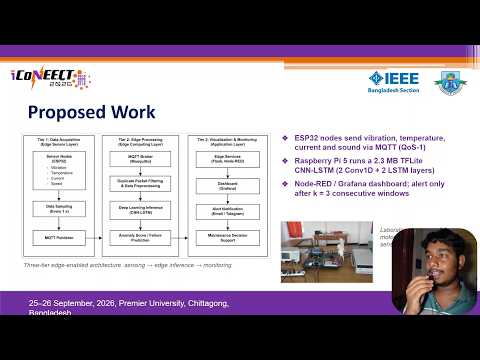
Edge-Enabled Deep Learning Framework for Predictive Maintenance in Industrial IoT Environments
Happy to share that our research paper has been accepted at iCONEECT 2026, hosted by Premier University, Chattogram. I presented it online on 26 September. The question we set out to answer: can deep learning catch a machine failure before it happens, without relying on the cloud and on a small Raspberry Pi 5? We collected sensor data with an ESP32, sent it over MQTT and ran a TensorFlow Lite model right on the edge device. Across five types of failure, our system gave a warning roughly 10 to 23 minutes in advance. That is enough time for someone to step in and save the machine. Grateful to my co-authors Abdullah Al Galib Tonmoy, Md Imtiaz Ahmed, Shah Md Riazul Islam Riaz and Debdatta Mallick for being part of this journey. Sharing my presentation certificate and certificate of appreciation below. 🙂
 3 Photos
AI Hackathon, AI Dev Fest 2026
On October 7, 2026, our team Three Builder’s took part in the AI Hackathon at AI Dev Fest 2026, organized by DIU CPC, Department of CSE, Daffodil International University. I was the team captain. We built upay Voice Guard, a voice AI agent for elderly people who can’t use the mobile app. They just call and speak to cash out, send money, check balance, or get a transaction report. The agent asks for a PIN and repeats the amount and number before any money moves. The hardest part was making the Bangla voice sound natural. Team: Md. Tanjimul Islam Tamim and MD. Jahid Hasan.

Pathway to Software Engineering
Completed all steps of the Pathway to Software Engineering course by Bohubrihi. The course gave an overview of how software is built and how to start a career in it. Topics included Git and GitHub, command line basics, backend and REST API basics, frontend for web and mobile apps, authentication and authorization, databases (SQL, NoSQL and ORMs), the software development process and communication and career tips for a first job.